Open Source — Koda AI An AI agent built
around verification.

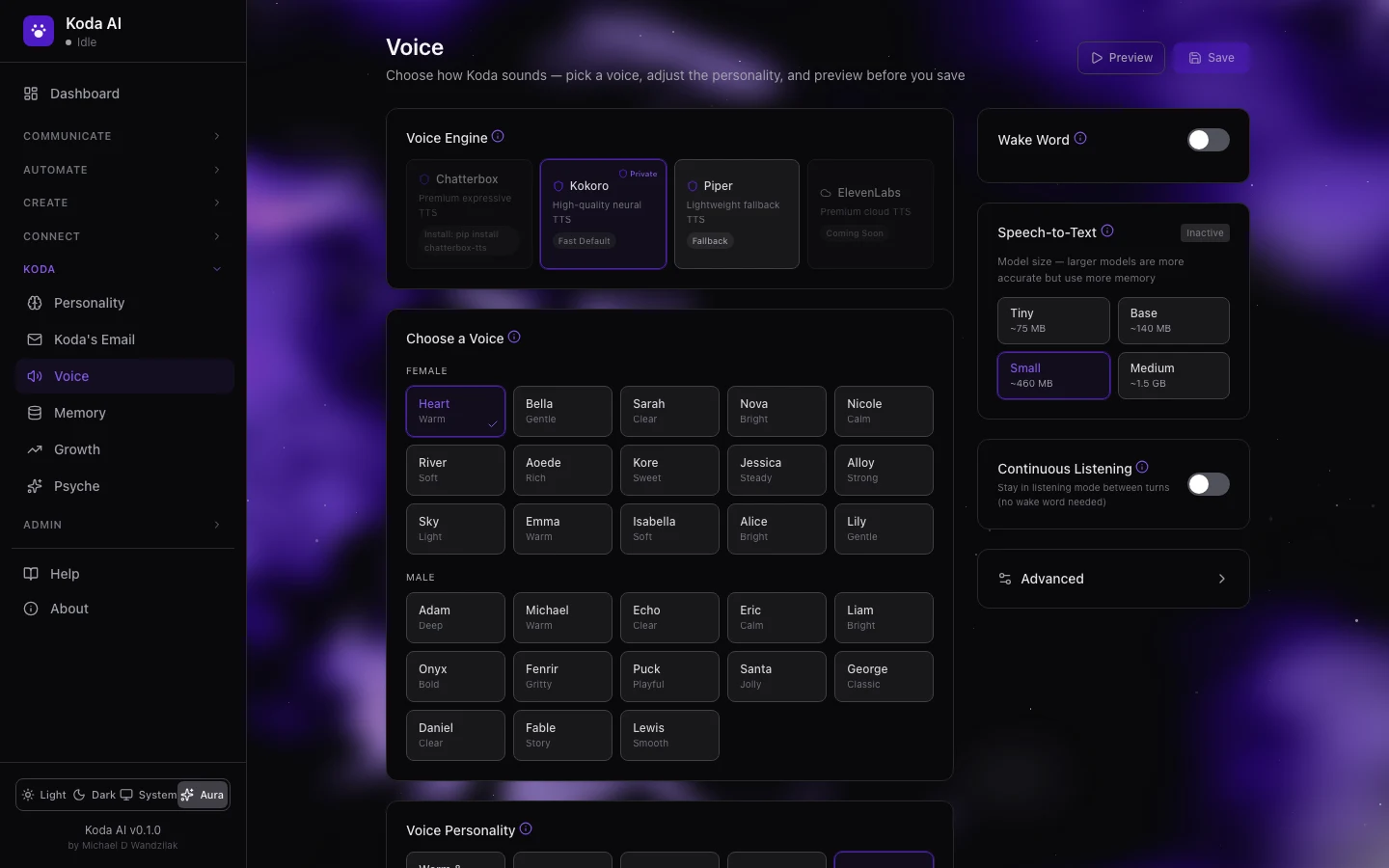
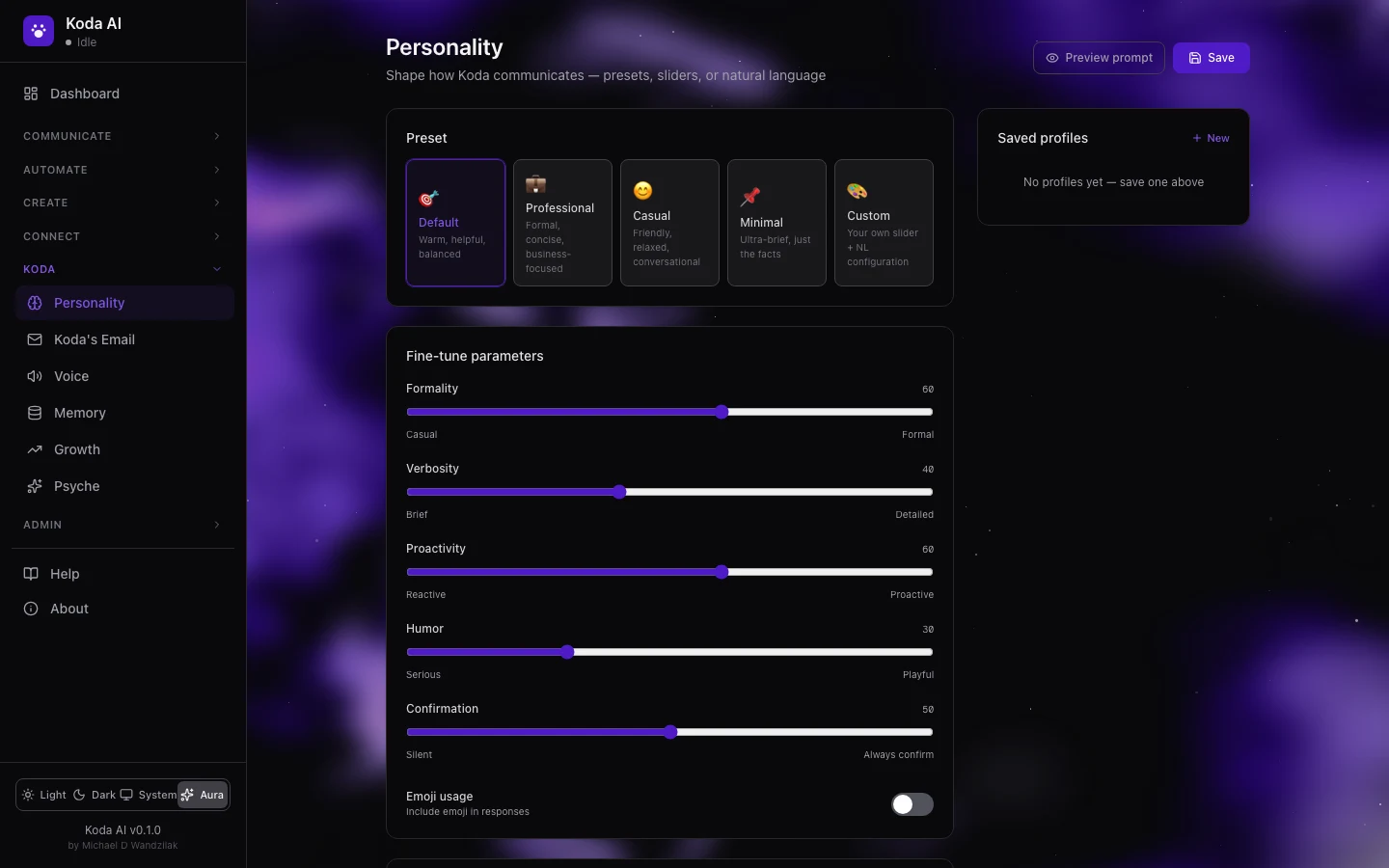
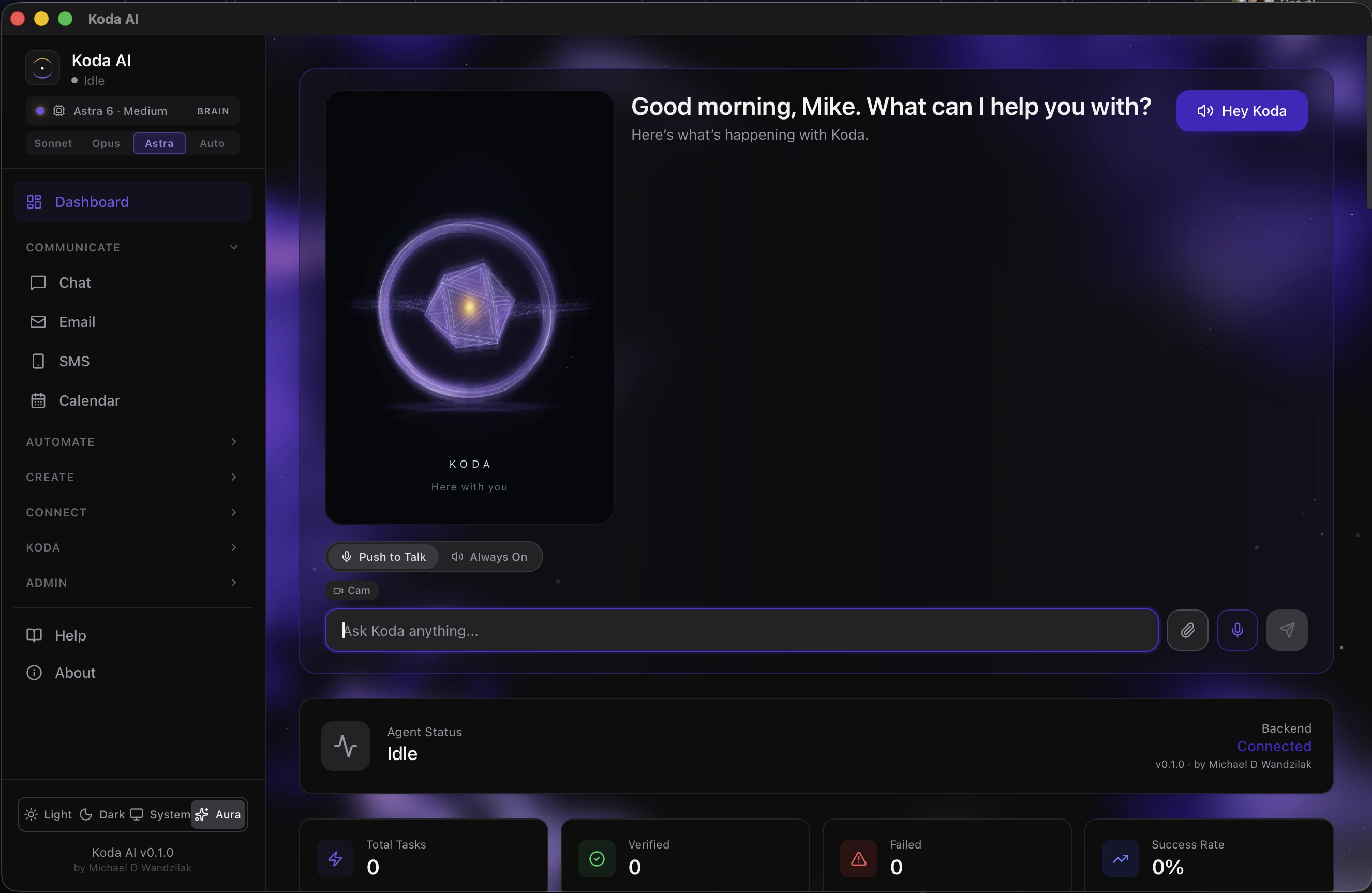
‌‌‌‌​​‌‌​‍‌​‌​‌‌‍‍‌​‍‌‌​​‌​​‌‌​‍ Koda is a self-hosted AI agent this studio built from scratch — with an encrypted credential vault, task-result verification, and deny-by-default permissions. These safeguards grew from the studio's experience with credential handling and task verification. Her core components are now open source, MIT licensed, on GitHub, ready to drop into your own agent.

WHY KODA EXISTS

Why we
built Koda.

In early 2026 we installed one of the popular open-source AI agents to run parts of this studio. It reported unfinished tasks as complete. It kept credentials in plaintext on disk. We built Koda with a credential vault, task-result verification, and permission checks for risky actions. Those components make the agent's actions easier to inspect and control. We named her Koda — Lakota for friend — and ran her daily on real client work.

"He built me to be the opposite: honest, secure, and kind." — from Koda's own seed memories, February 2026 (shipped in koda-memory)
SIX COMPONENTS · 254 PASSING TESTS · MIT

Use Koda's components
for verification and control.

Each package is extracted straight from Koda's production backend, stands alone with minimal dependencies, ships with its full test suite, and installs with one line of pip. No signup, no telemetry, no strings.

koda-vault

Encrypted credential storage for agents that handle real accounts.

  • AES-256-GCM encryption, Argon2 key derivation
  • Scoped retrieval checks the permission scope supplied by the caller.
  • Every access written to an audit log
pip install git+https://github.com/HeyKodaAI/koda-vault.git
50 tests ✓ GitHub

koda-verify

Independent checks for reported task results.

  • Checks the actual disk / API result, not the agent's claim
  • Pluggable verification strategies per action type
  • Six verdicts, stored with evidence for audit
pip install git+https://github.com/HeyKodaAI/koda-verify.git
45 tests ✓ GitHub

koda-permissions

Deny-by-default action gating with four risk tiers.

  • 70+ built-in action definitions across 16 services
  • Shell and code-modification actions are CRITICAL tier
  • Nothing runs until its scopes are explicitly enabled
pip install git+https://github.com/HeyKodaAI/koda-permissions.git
52 tests ✓ GitHub

koda-workflows

DAG automation with real branching and pause/resume.

  • Triggers, conditions, actions, transforms, delays
  • Cycle and dangling-reference validation before any run
  • Human-approval pauses built into the state machine
pip install git+https://github.com/HeyKodaAI/koda-workflows.git
31 tests ✓ GitHub

koda-router

Route tasks by estimated complexity, model tier, cost, and latency.

  • Multi-signal complexity scoring, not keyword matching
  • Cost budgets, latency requirements, fallback chains
  • Destructive-sounding requests escalate to the strongest model
pip install git+https://github.com/HeyKodaAI/koda-router.git
28 tests ✓ GitHub

koda-memory

Persistent, tiered memory with checks for recognized secret patterns.

  • Short/medium/long-term + episodic tiers
  • Secret-pattern checks help identify credentials before storage
  • Category-level privacy controls, full export and wipe
pip install git+https://github.com/HeyKodaAI/koda-memory.git
48 tests ✓ GitHub
QUICKSTART OUTPUT

Verification results
in the terminal.

These are unedited runs of the README quickstarts. In the first, the result dict claims a file was written — koda-verify checks the disk and reports the missing file. In the second, koda-memory catches a credential before it can be stored.

koda-verify — quickstart
verified - File verified on disk: /tmp/quarterly-report.txt (11 bytes, written 0s ago)
failed - File does NOT exist at /tmp/never-written.txt despite reported success
next steps: ['Try the action again', 'Check the audit log for more details']
koda-memory — secret detector
SecretDetection(detected=True, confidence=0.95, type='token', service='github')
my github token is [CREDENTIAL_STORED_IN_VAULT]
koda-router — three requests, three tiers
'hey, good morning'                                    → claude-haiku   simple
'Refactor the auth module, then add tests, update docs' → claude-sonnet  moderate
'Delete the production database backups'               → claude-opus    critical
WHAT THESE ARE ACTUALLY FOR

Components for
your agent's infrastructure.

Choose the packages that fit your credential storage, verification, permission, workflow, routing, and memory needs. Plain Python, minimal dependencies, pip install from GitHub. The examples below show how to use each component.

koda-vault

Your agent needs your Gmail token, your Stripe key, your server passwords. Where are they right now — a .env file? Pasted into its prompt? The vault stores them AES-256 encrypted, checks a supplied permission scope before retrieval, and records access in an audit log. The provider permissions attached to the credential determine what it can do once retrieved.

Show the code
from koda_vault import AuditLogger, CredentialVault, VaultStorage, derive_master_key

key, salt = derive_master_key("correct horse battery staple")
storage = VaultStorage("vault.db")
vault = CredentialVault(storage=storage, encryption_key=key, audit=AuditLogger(storage))

vault.store(name="work-gmail", service="gmail",
            scopes=["gmail:read", "gmail:send"], value="ya29.oauth-token")

# caller identity + required scope are enforced and audited
token = vault.retrieve(name="work-gmail", service="gmail",
                       requested_by="email-engine", required_scope="gmail:send")

koda-verify

A completion message needs supporting evidence. Wrap its actions in a verifier that goes and checks — is the file really on disk, did the API really return an ID — before success gets reported. If the claim doesn't survive contact with reality, it's reported as failed, with evidence.

Show the code
from koda_verify.verifier import TaskVerifier

verifier = TaskVerifier()

# the agent wrote a file and claims success — check the actual disk
task = verifier.create_task("filesystem:write_files", service="filesystem")
outcome = verifier.verify(task, raw_result={"path": "/tmp/quarterly-report.txt"})
print(outcome.verification.status.value)   # verified — the file is really there

# the agent CLAIMS success, but nothing was ever written
task = verifier.create_task("filesystem:write_files", service="filesystem")
outcome = verifier.verify(task, raw_result={"path": "/tmp/never-written.txt",
                                            "success": True})
print(outcome.verification.status.value)   # failed — the claim did not survive

koda-permissions

You wouldn't give a new hire root on day one. Deny-by-default means your agent can do nothing until you enable that specific scope — and risky actions (send email in bulk, run shell commands, delete anything) route through an approval queue you control.

Show the code
from koda_permissions.manager import PermissionManager
from koda_permissions.models import RiskTier
from koda_permissions.registry import ActionRegistry
from koda_permissions.storage import PermissionStorage

manager = PermissionManager(ActionRegistry(), PermissionStorage("permissions.db"))

manager.check("gmail:send_email").allowed        # False — deny by default

manager.enable_scope("gmail", "send", risk_tier=RiskTier.MEDIUM)
manager.check("gmail:send_email").allowed        # True — you turned it on

# HIGH-tier actions go through an approval queue you control
manager.enable_scope("gmail", "delete")
req = manager.request_approval("gmail:delete_email",
                               description="Delete 3 newsletters")
manager.resolve_approval(req, approved=True)

koda-memory

The package combines tiered memory and LLM-ready context windows with checks for recognized credentials in incoming text. Detected credentials can be redacted before storage.

Show the code
from koda_memory.manager import MemoryManager
from koda_memory.secret_detector import SecretDetector
from koda_memory.storage import MemoryStorage

manager = MemoryManager(MemoryStorage("memory.db"))
manager.remember("Prefers dark mode and concise answers", key="ui_preferences")

for item in manager.recall("dark mode"):
    print(item.key, "->", item.content)

# catch credentials BEFORE they're written to memory
detector = SecretDetector()
result = detector.scan("my github token is ghp_...")
if result.detected:
    print(detector.redact(result.original_message, result))

koda-workflows

For the recurring job with a human sign-off in the middle: define it as a graph of steps — triggers, conditions, transforms — validated for cycles before it runs, with pause-for-approval built into the state machine.

Full examples in the README →

koda-router

The router estimates each request's complexity and selects a model using tier, cost, and latency settings. Requests flagged as dangerous are routed to a model in the configured higher tier.

Full examples in the README →

All snippets above are the actual README quickstarts — every one executed successfully before it was published. That's kind of our whole thing.

BRING IT TO YOUR AGENT

Works Where Your Agent Works.

Every component is a plain Python library with a FastAPI surface where it makes sense — so any agent that can call HTTP can use them today. Python agent frameworks import them directly. And an MCP server exposing the vault, verifier, and permissions as Model Context Protocol tools is in the works, which puts these components one config entry away from OpenClaw, Claude Code, Cursor, and any other MCP-capable agent.

Python agents — direct import Any agent — FastAPI / HTTP OpenClaw · Claude Code · Cursor — MCP (coming)
GET THE CODE

MIT Licensed. No Catch.

All six repositories live under the HeyKodaAI organization on GitHub. Use them, fork them, ship them. If you'd like help wiring honest-agent infrastructure into your own product, that's what this studio does.